
AC sizing for Florida homes
Understand tonnage, BTUs and square footage before choosing your next air conditioner. This guide explains the starting points and why a Manual J load calculation matters for your home.
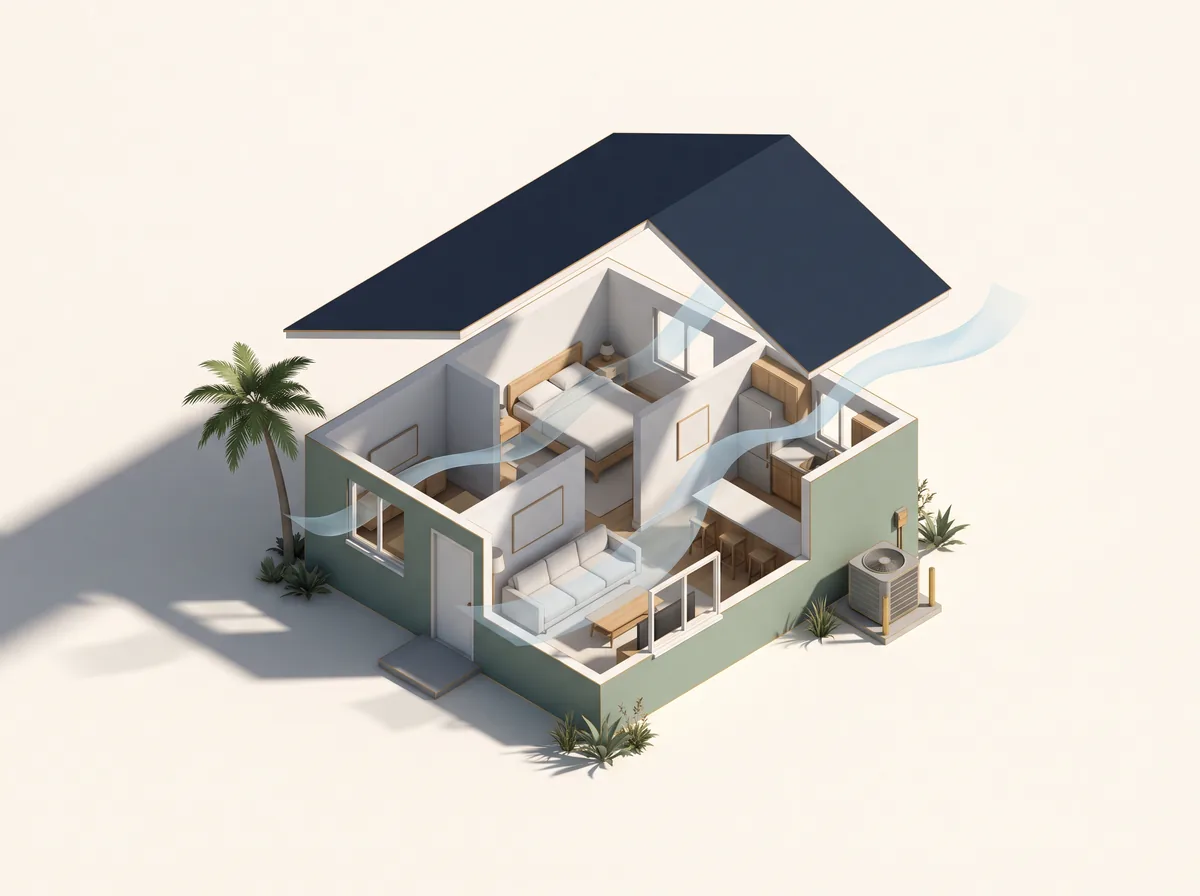
How many square feet does a 3-ton AC cool in Florida?
A 3-ton air conditioner (36,000 BTU) typically serves 1,500 to 1,800 square feet in Florida homes. However, Florida's high humidity, intense sun exposure, and long cooling seasons often require 500–600 sq ft per ton instead of the national average of 600–700 sq ft per ton. Final sizing must include a Manual J load calculation that accounts for your home's windows, insulation, ceiling height, duct condition, shade, and air leakage. For a Pinellas County or Tampa Bay home, never size an AC system from square footage alone. Call Hales AC at 727-398-5515 for a free in-home load calculation and sizing estimate.
AC tonnage and square footage chart
This table shows general sizing guidance for Florida homes. These ranges are starting points only — your home's actual cooling load depends on insulation, windows, ductwork, shade, ceiling height, and air leakage. A Manual J calculation is required for right-sized equipment.
On a small screen, scroll the chart to compare all columns.
| AC Tonnage | BTU Rating | Florida Sq Ft Range | National Sq Ft Range | Best For (Florida) |
|---|---|---|---|---|
| 1.5 Ton | 18,000 BTU | 600 – 900 sq ft | 750 – 1,050 sq ft | Small condo, apartment, single room addition |
| 2 Ton | 24,000 BTU | 901 – 1,200 sq ft | 1,000 – 1,400 sq ft | Small home, 2-bedroom condo, townhouse |
| 2.5 Ton | 30,000 BTU | 1,201 – 1,500 sq ft | 1,250 – 1,750 sq ft | Medium condo, smaller 3-bedroom home |
| 3 Ton | 36,000 BTU | 1,501 – 1,800 sq ft | 1,500 – 2,100 sq ft | Typical 3-bedroom Florida home (1,500–1,800 sq ft) |
| 3.5 Ton | 42,000 BTU | 1,801 – 2,100 sq ft | 1,750 – 2,450 sq ft | Larger 3-bedroom, smaller 4-bedroom home |
| 4 Ton | 48,000 BTU | 2,101 – 2,400 sq ft | 2,000 – 2,800 sq ft | 4-bedroom home, open floor plans |
| 5 Ton | 60,000 BTU | 2,401 – 3,000 sq ft | 2,500 – 3,500 sq ft | Large home, multi-story, or two-system setup |
Important: These are estimates. A Manual J load calculation is the only correct way to size an AC system. Undersized equipment won't cool on the hottest days; oversized equipment short-cycles, leaves humidity behind, and wears out faster.
Why Florida AC Sizing Is Different
National AC sizing charts typically use 600–700 square feet per ton. But Florida homes face conditions that change the math:
Extreme Humidity
Florida's 70–90% humidity means your AC must remove moisture and cool the air. An oversized system cools too fast and never runs long enough to dehumidify — leaving you cold and clammy. Right-sizing for latent (moisture) load is critical in Pinellas County and Tampa Bay.
Intense Solar Gain
Florida homes with west-facing windows or limited shade can add 10–20% to the cooling load compared to identical square footage in northern states. A home with a dark roof and no shade trees may need 500 sq ft per ton instead of 600.
8–10 Month Cooling Season
Your AC in St. Petersburg, Clearwater, or Largo runs far more hours per year than a system in Ohio or Michigan. The wear-and-tear and energy cost of an undersized system are amplified by Florida's nearly year-round cooling demand.
Older Florida Homes
Many Pinellas County homes built before 1990 have less insulation, single-pane windows, and leaky ductwork — all of which increase the effective cooling load. A 1,500 sq ft 1970s home may need the same tonnage as a well-insulated 1,800 sq ft newer build.
How to Calculate AC Size: Square Footage Per Ton
The basic formula for estimating AC size is:
Home Square Footage ÷ Square Feet Per Ton = Estimated Tonnage
For Florida homes, use 500–600 sq ft per ton (more conservative than the national 600–700).
Example Calculations for Florida Homes
- 1,200 sq ft home ÷ 550 = ~2.2 tons → likely a 2-ton or 2.5-ton AC (Manual J confirms)
- 1,500 sq ft home ÷ 550 = ~2.7 tons → likely a 2.5-ton or 3-ton AC
- 1,800 sq ft home ÷ 550 = ~3.3 tons → likely a 3-ton or 3.5-ton AC
- 2,000 sq ft home ÷ 550 = ~3.6 tons → likely a 3.5-ton or 4-ton AC
- 2,400 sq ft home ÷ 550 = ~4.4 tons → likely a 4-ton or 5-ton AC (or two smaller systems)
These are estimates, not specifications. The only reliable method is a Manual J load calculation performed by a licensed HVAC contractor. Hales AC provides free in-home load calculations for Pinellas County homeowners — call 727-398-5515 to schedule.
What Is a Manual J Load Calculation?
A Manual J load calculation is the industry-standard method (ACCA Manual J, 8th Edition) for determining the correct heating and cooling load for a residential building. It's required by Florida Building Code for new HVAC installations and strongly recommended for replacements. Unlike square-footage rules of thumb, Manual J accounts for:
Building Envelope
Wall insulation R-value, attic insulation depth, window type (single vs. double pane), and air leakage measured by a blower door test.
Orientation & Glass
Which direction windows face, total glass area, overhang shading, and whether windows have low-E coatings or solar screens.
Internal Loads
Number of occupants, kitchen appliances, lighting type (LED vs. incandescent), and electronics that add heat to the conditioned space.
Latent Load
Florida's outdoor humidity and the moisture generated indoors by cooking, showers, and breathing — the "hidden" load an AC must remove.
Duct Condition
Duct location (attic vs. conditioned space), insulation R-value, leakage rate, and whether ducts are sized correctly for the airflow the system needs.
Site Factors
Shade from trees or adjacent buildings, reflective roofing materials, and whether the home is exposed to coastal salt air (common in Pinellas beach communities).
Hales AC has performed Manual J calculations on Pinellas County homes since 1986. We use Wrightsoft Right-J® or equivalent ACCA-approved software. A Manual J typically takes 45–90 minutes on site and is the foundation of every AC installation and replacement estimate we provide.
Common AC Sizing Questions for Florida Homeowners
How many square feet will a 3-ton AC unit cool in Florida?
A 3-ton AC unit (36,000 BTU) typically cools 1,500 to 1,800 square feet in a Florida home when the system is properly sized with a Manual J load calculation. In a well-insulated newer home with good shade, a 3-ton may handle up to 1,900–2,000 sq ft. In an older, leaky Pinellas County home with single-pane windows and poor attic insulation, a 3-ton may only handle 1,400–1,600 sq ft. Never size from square footage alone — call Hales AC at 727-398-5515 for a free load calculation.
How many square feet does a 3.5-ton AC unit cool?
A 3.5-ton air conditioner (42,000 BTU) typically serves 1,800 to 2,100 square feet in Florida homes. This is a common size for larger 3-bedroom homes in St. Petersburg, Clearwater, and Largo, or for smaller 4-bedroom homes where the floor plan is relatively open. As always, Manual J is required — a 3.5-ton in a home with cathedral ceilings, large west-facing windows, and attic ducts in a hot Florida attic may only handle 1,700 sq ft effectively.
How many BTUs is a 3-ton air conditioner?
A 3-ton air conditioner is 36,000 BTU (British Thermal Units) per hour. The conversion is straightforward: 1 ton of cooling = 12,000 BTU/hr. So 1.5 tons = 18,000 BTU, 2 tons = 24,000 BTU, 2.5 tons = 30,000 BTU, 3 tons = 36,000 BTU, 3.5 tons = 42,000 BTU, 4 tons = 48,000 BTU, and 5 tons = 60,000 BTU. The term "ton" dates back to when cooling was measured by how much ice (in tons) it would take to produce the same cooling effect over 24 hours.
How many square feet per ton for AC in Florida?
In Florida, plan for roughly 500–600 square feet per ton of cooling capacity. This is more conservative than the national guideline of 600–700 sq ft per ton because Florida homes face higher humidity (latent load), intense solar gain, longer cooling seasons, and often have ductwork in unconditioned attics. A 1,800 sq ft Florida home might need 3 to 3.5 tons, while the same square footage in a northern climate might only need 2.5 to 3 tons.
How many square feet does a 2.5-ton AC cover in Florida?
A 2.5-ton AC (30,000 BTU) typically covers 1,200 to 1,500 square feet in Florida. This is a common size for mid-size condos, smaller single-family homes, and well-insulated townhouses in Pinellas County. In a newer, energy-efficient home with double-pane windows and R-38 attic insulation, a 2.5-ton unit may handle up to 1,600 sq ft.
What happens if my AC is oversized?
An oversized AC system causes several problems: short cycling (the system turns on and off frequently without completing a full cooling cycle), poor dehumidification (the system cools the air too fast to remove moisture, leaving the home cold and clammy), higher energy bills (frequent starts draw more power), uneven temperatures (some rooms get cold while others stay warm), and shorter equipment life (more starts = more wear on the compressor and fans). In Florida's humid climate, oversizing is especially damaging because humidity control matters as much as temperature control.
What happens if my AC is undersized?
An undersized AC system cannot keep up on the hottest Florida days. It will run constantly, never reach the thermostat setpoint, and may still leave the home uncomfortably warm. Undersized equipment also runs longer cycles, which increases energy consumption and wear. In a multi-story home, an undersized system often leaves the upstairs 5–10°F warmer than downstairs. If your AC runs all day and can't cool below 78°F in August, it may be undersized — or it may have a duct, refrigerant, or maintenance issue.
How do I know what size AC my home currently has?
Check the model number on the outdoor condenser unit's data plate. Most manufacturers encode the tonnage in the model number. Look for a number divisible by 12: "36" = 3 tons (36,000 ÷ 12,000 = 3), "24" = 2 tons, "30" = 2.5 tons, "42" = 3.5 tons, "48" = 4 tons, "60" = 5 tons. You can also find the BTU rating listed directly on the data plate. If you're unsure, a Hales AC technician can identify your system size during a service call or free estimate.
Can I replace my AC with a different tonnage than the original?
Yes — and it's often the right call. Many older Florida homes have AC systems that were sized by rule of thumb (or chosen based on what was in stock) rather than by Manual J calculation. If a load calculation shows the current system is oversized or undersized, right-sizing the replacement improves comfort, humidity control, and efficiency. However, changing tonnage may require duct modifications — oversized ducts on a smaller system can reduce airflow velocity, while undersized ducts on a larger system can cause noise and static pressure problems. Hales AC evaluates both the equipment and the ducts during every replacement estimate.
Does ductwork size matter for AC tonnage?
Yes — ductwork must be sized to match the AC system's airflow requirements. A typical 3-ton AC needs roughly 1,200 CFM (cubic feet per minute) of airflow, or about 400 CFM per ton. Undersized ducts restrict airflow, causing high static pressure, noisy operation, frozen coils, and reduced efficiency. Oversized ducts on a smaller system can result in low air velocity and poor air mixing. If you're replacing a 2-ton system with a 3-ton system, the existing ducts may need to be enlarged or supplemented. Hales AC includes a duct assessment with every replacement estimate.
AC Sizing + Efficiency: Why Both Matter in Florida
Right-sizing is only half the equation. The SEER2 rating (Seasonal Energy Efficiency Ratio 2) determines how efficiently the right-sized system runs. As of 2023, the Department of Energy requires a minimum SEER2 of 14.3 in Florida (Southeast region) for split systems under 45,000 BTU/h. Higher SEER2 ratings mean lower operating costs — especially important when your AC runs 2,000–3,000 hours per year in Pinellas County.
Right-Sized + High SEER2 = Best Value
A correctly sized 3-ton, 18 SEER2 system may use 30–40% less electricity than an oversized 4-ton, 14 SEER2 system — even though the tonnage is smaller. The savings come from longer, more efficient run cycles and better humidity control.
Variable-Speed / Inverter Systems
Variable-speed (inverter) AC systems can modulate their output between roughly 30% and 100% of rated capacity. A 3-ton inverter system running at 40% capacity on a mild day behaves like a 1.2-ton system — eliminating the short-cycling problem of oversized single-stage equipment. These systems pair especially well with Florida's wide range of cooling needs.
Hales AC installs right-sized, high-efficiency systems from leading manufacturers with financing options available. Call 727-398-5515 or book online for a free replacement estimate with a Manual J load calculation.
Related AC Services in Pinellas County & Tampa Bay
AC Installation & Replacement
Right-sized AC installation with Manual J load calculation. Serving St. Petersburg, Clearwater, Largo, Seminole, and all Pinellas County since 1986.
AC Size & BTU Calculator
Run the planning math yourself: enter home size, ceiling height, insulation, sun exposure, and occupancy for a BTU/h and tonnage estimate. The default lands inside this guide's 500–600 sq ft per ton range, and each result shows its own sq ft per ton against it.
Duct Replacement & Repair
Ductwork must match your AC tonnage. Leaky, undersized, or poorly insulated ducts waste 20–30% of your cooled air. Duct assessment included with every estimate.
AC Repair
If your current AC can't keep up, it may be undersized or need repair. Hales AC diagnoses and fixes cooling problems with upfront pricing.
AC Maintenance & Tune-Ups
Even a right-sized system loses efficiency without maintenance. Annual tune-ups keep your AC running at rated capacity through Florida's long cooling season.
AC Financing Options
Right-sized replacement systems with flexible financing. Apply online or ask your Hales AC technician about current offers during your estimate.
Emergency AC Repair — 24/7
AC failure in the Florida heat is an emergency. Hales AC offers 24/7 scheduling across Pinellas County and confirms the earliest available appointment when you book.
Get a Free Manual J Load Calculation for Your Pinellas County Home
Don't guess your AC size. A Manual J load calculation from Hales AC is the only way to right-size your system for Florida's heat and humidity. Free with your replacement estimate.
📞 Call 727-398-5515